
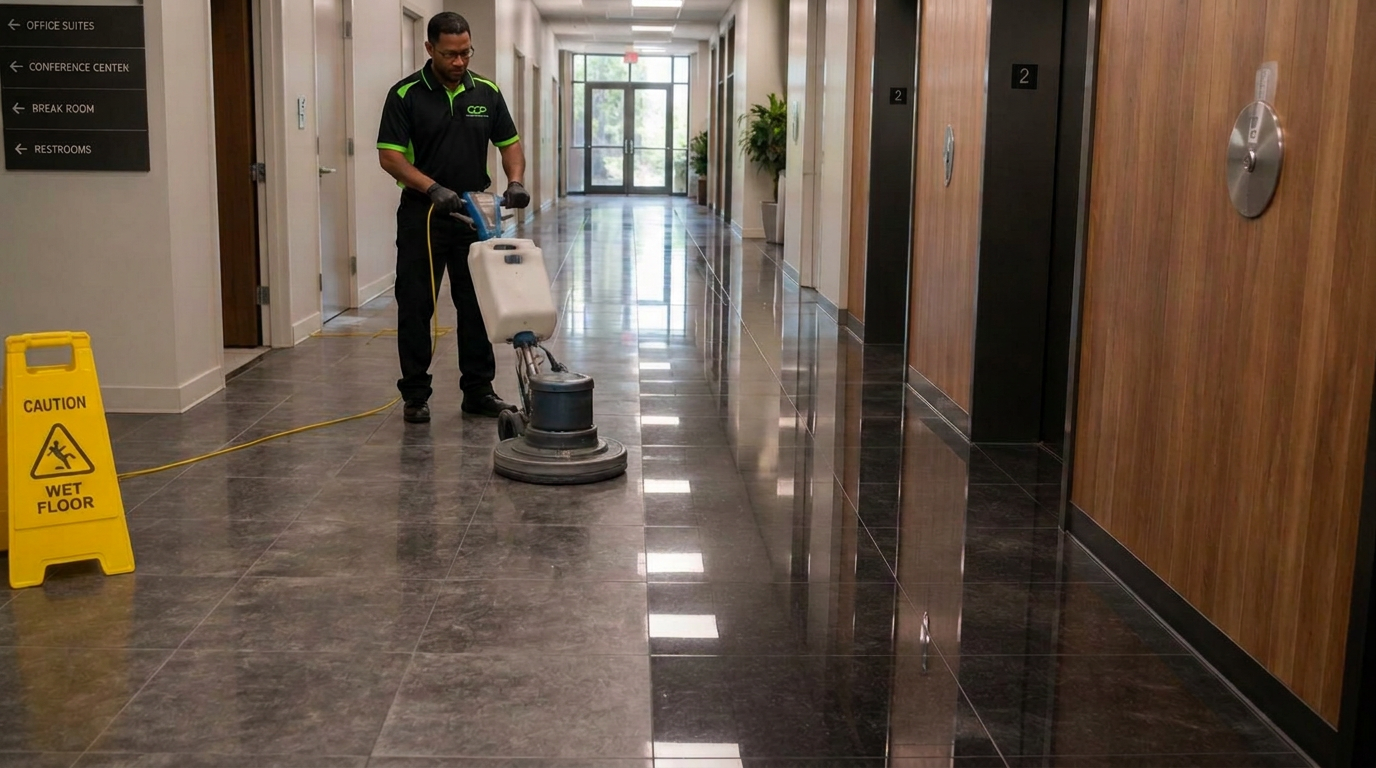
Facility managers in Birmingham ask for "a wax job" and get quoted three very different things. One bidder means a scrub and recoat. Another means a full strip and refinish. A third means a burnish pass that will look great for two weeks. They are not the same service, they do not cost the same, and choosing the wrong one is the most common reason a floor looks tired six weeks after you paid for it.
What Floor Stripping Actually Is
Stripping is removal. A commercial stripping solution is applied to the floor, given full dwell time, agitated with a machine, then wet-vacuumed off along with every layer of old finish, embedded soil, and yellowing buildup. Edges, corners, and the ridge of old wax along baseboards get scraped by hand — that detail is where cheap jobs get skipped.
Stripping alone leaves you with bare, unprotected tile. It is a preparation step, not a finished result. A floor that has been stripped and not refinished is more vulnerable than it was before, because the wear layer that was taking the abuse is gone.
What Floor Waxing Actually Is
Waxing is protection. After the floor is neutralized and rinsed, thin coats of commercial floor finish go down about 30 minutes apart — typically four to six coats depending on traffic. That finish is a sacrificial layer: foot traffic, carts, and grit wear the wax instead of your tile. Burnishing afterward brings the gloss up without glazing the surface.
Wax applied over a floor that was not properly stripped and neutralized is the single most common failure we get called to fix in Birmingham buildings. It looks fine for a month, then yellows, powders, and peels along the traffic lanes — because the new coats bonded to old residue instead of the tile.
Stripping vs. Waxing: Which One Does Your Floor Need?
Strip and wax (full service) when the finish is yellowed, discolored, or peeling; when you can see dark buildup along baseboards and corners; when the shine no longer returns after burnishing; or when it has been more than a year since the last full refinish.
Scrub and recoat (the lighter option) when the finish is still intact but dull and scuffed, with no yellowing or peeling. An auto-scrubber removes the top layer of soiled finish and one or two fresh coats go back down. It costs far less than a full strip and, done every three to four months, it is what pushes a full strip out to once a year.
Burnish only when the floor is clean and the finish is sound, and you just want gloss back before an inspection, an audit, or a client visit.
A Realistic Birmingham Schedule
For most offices, clinics, schools, and retail spaces around Birmingham and Hoover, the program that actually works is: one full strip and wax per year, scrub and recoat every three to four months, weekly damp mopping with a neutral cleaner, and monthly burnishing in entries and corridors. High-traffic lobbies, cafeterias, and school hallways often move to quarterly recoats. Low-traffic back offices can stretch to a single annual strip.
Alabama humidity matters here. Finish cures more slowly in a humid building, so scheduling matters as much as product choice. We run this work overnight, on weekends, or over a holiday closure so the floor has time to set before your doors open.
Which Floors Should Be Stripped and Waxed
VCT is the classic strip-and-wax floor and the one most Birmingham offices, clinics, and schools are standing on. LVT, sheet vinyl, and linoleum take a lighter finish, often a manufacturer-specific product to keep the flooring warranty intact.
Terrazzo and sealed concrete are maintained with the right sealer and a burnishing schedule rather than heavy wax that would trap soil. Polished concrete, epoxy, and most luxury vinyl plank should never be waxed at all — if a bidder offers to wax those, that is a red flag.
Questions to Ask Any Bidder
Ask whether the price includes stripping or just recoating. Ask whether they neutralize and rinse before the first coat. Ask how many coats, and whether furniture moving is included or billed separately. Ask when the work happens — a daytime crew working around your staff cannot do this job properly. Ask for a flat price by square footage rather than an hourly estimate.
What This Costs Around Birmingham
Strip-and-wax is priced by square footage, floor condition, coat count, and how much furniture has to move. A small office suite is usually a single overnight shift; a school corridor or church fellowship hall is typically a weekend project. Recurring scrub-and-recoat folded into an existing janitorial program costs far less per visit than mobilizing a standalone crew.
Get a Straight Answer on Your Floors
Cleaning Concepts Plus is locally owned, BBB A+ accredited, and has been refinishing commercial floors across Birmingham, Hoover, Bessemer, Helena, Pelham, Alabaster, Homewood, Vestavia Hills, Mountain Brook, Trussville, Leeds, Moody, and Calera since 2004. We will walk your floor, tell you honestly whether you need a strip or just a recoat, and quote a flat price.
See our floor stripping and waxing service in Birmingham for scope, service areas, and scheduling, or read more about our commercial floor waxing program. If your floors only need cleaning rather than refinishing, start with floor scrubbing and stripping.
What Floor Stripping Actually Is
Stripping is removal. A commercial stripping solution is applied to the floor, given full dwell time, agitated with a machine, then wet-vacuumed off along with every layer of old finish, embedded soil, and yellowing buildup. Edges, corners, and the ridge of old wax along baseboards get scraped by hand — that detail is where cheap jobs get skipped.
Stripping alone leaves you with bare, unprotected tile. It is a preparation step, not a finished result. A floor that has been stripped and not refinished is more vulnerable than it was before, because the wear layer that was taking the abuse is gone.
What Floor Waxing Actually Is
Waxing is protection. After the floor is neutralized and rinsed, thin coats of commercial floor finish go down about 30 minutes apart — typically four to six coats depending on traffic. That finish is a sacrificial layer: foot traffic, carts, and grit wear the wax instead of your tile. Burnishing afterward brings the gloss up without glazing the surface.
Wax applied over a floor that was not properly stripped and neutralized is the single most common failure we get called to fix in Birmingham buildings. It looks fine for a month, then yellows, powders, and peels along the traffic lanes — because the new coats bonded to old residue instead of the tile.
Stripping vs. Waxing: Which One Does Your Floor Need?
Strip and wax (full service) when the finish is yellowed, discolored, or peeling; when you can see dark buildup along baseboards and corners; when the shine no longer returns after burnishing; or when it has been more than a year since the last full refinish.
Scrub and recoat (the lighter option) when the finish is still intact but dull and scuffed, with no yellowing or peeling. An auto-scrubber removes the top layer of soiled finish and one or two fresh coats go back down. It costs far less than a full strip and, done every three to four months, it is what pushes a full strip out to once a year.
Burnish only when the floor is clean and the finish is sound, and you just want gloss back before an inspection, an audit, or a client visit.
A Realistic Birmingham Schedule
For most offices, clinics, schools, and retail spaces around Birmingham and Hoover, the program that actually works is: one full strip and wax per year, scrub and recoat every three to four months, weekly damp mopping with a neutral cleaner, and monthly burnishing in entries and corridors. High-traffic lobbies, cafeterias, and school hallways often move to quarterly recoats. Low-traffic back offices can stretch to a single annual strip.
Alabama humidity matters here. Finish cures more slowly in a humid building, so scheduling matters as much as product choice. We run this work overnight, on weekends, or over a holiday closure so the floor has time to set before your doors open.
Which Floors Should Be Stripped and Waxed
VCT is the classic strip-and-wax floor and the one most Birmingham offices, clinics, and schools are standing on. LVT, sheet vinyl, and linoleum take a lighter finish, often a manufacturer-specific product to keep the flooring warranty intact.
Terrazzo and sealed concrete are maintained with the right sealer and a burnishing schedule rather than heavy wax that would trap soil. Polished concrete, epoxy, and most luxury vinyl plank should never be waxed at all — if a bidder offers to wax those, that is a red flag.
Questions to Ask Any Bidder
Ask whether the price includes stripping or just recoating. Ask whether they neutralize and rinse before the first coat. Ask how many coats, and whether furniture moving is included or billed separately. Ask when the work happens — a daytime crew working around your staff cannot do this job properly. Ask for a flat price by square footage rather than an hourly estimate.
What This Costs Around Birmingham
Strip-and-wax is priced by square footage, floor condition, coat count, and how much furniture has to move. A small office suite is usually a single overnight shift; a school corridor or church fellowship hall is typically a weekend project. Recurring scrub-and-recoat folded into an existing janitorial program costs far less per visit than mobilizing a standalone crew.
Get a Straight Answer on Your Floors
Cleaning Concepts Plus is locally owned, BBB A+ accredited, and has been refinishing commercial floors across Birmingham, Hoover, Bessemer, Helena, Pelham, Alabaster, Homewood, Vestavia Hills, Mountain Brook, Trussville, Leeds, Moody, and Calera since 2004. We will walk your floor, tell you honestly whether you need a strip or just a recoat, and quote a flat price.
See our floor stripping and waxing service in Birmingham for scope, service areas, and scheduling, or read more about our commercial floor waxing program. If your floors only need cleaning rather than refinishing, start with floor scrubbing and stripping.